॥ जय शद्राम ॥
A digital home for the worldwide sangat
Read the Shadani Granth, hear a bhajan and keep the Darbar close — wherever the sangat gathers.
Official updates॥ जय शद्राम ॥
Wherever you are, the Darbar is with you.
A quiet place to read, listen and stay close to the Shadani sangat.
परिचय
About Shadani Darbar
A short introduction to the Darbar, its Gaddisars and what this digital space holds.
The history of Shadani Darbar begins with Sant Shadaram Sahib, born in Lahore in October 1708. After years of pilgrimage he reached Mathelo in 1768 and later founded the Darbar at nearby Hayat Pitafi in Sindh, where he built a Shiv Mandir, lit the Dhuni Sahib and dug the sacred well.
Nine Gaddisars have guided the Darbar since Sant Shadaram Sahib, down to Sant Shri Dr. Yudhishthir Lal Ji today. The present spiritual seat is Shadani Darbar, Raipur, at Sant Shadani Nagar on Dhamtari Road in Chhattisgarh. Historic Darbar sites remain at Hayat Pitafi and Mathelo in Sindh, Pakistan, and a Darbar was established at Amravati in 1989.
This digital space brings together the Shadani Granth in 28 original scanned pages, 87 bhajans published on the official Shadani Darbars audio page, 17 videos from the official YouTube channel, the history of the nine Gaddisars and map references for each Darbar. It is an independent tribute, not the official Darbar website — please confirm timings, travel details and event dates with Darbar management.
Where is Shadani Darbar located?
The present spiritual seat is Shadani Darbar, Raipur, at Sant Shadani Nagar, Dhamtari Road, Chhattisgarh. Historic sites are at Hayat Pitafi and Mathelo in Sindh, Pakistan, and a Darbar was established at Amravati in 1989.
Who founded Shadani Darbar?
Sant Shadaram Sahib, born in Lahore in October 1708, founded the Darbar at Hayat Pitafi in Sindh after reaching Mathelo in 1768.
How many Gaddisars has Shadani Darbar had?
Nine, from Sant Shadaram Sahib (1708–1793) to Sant Shri Dr. Yudhishthir Lal Ji (born 1962), the present Gaddisar.
What can I read and listen to on this site?
The Shadani Granth as 28 original scanned pages in nine sections, 87 bhajans, 17 official videos, a nine-part history of the Gaddisars, Darbar locations with map references, and published event announcements.
॥ जय शद्राम ॥
Keep the Darbar close.
Install this space on your home screen, or share it with someone who would like to read, listen or find their way to a Darbar.
श्री शदाणी ग्रंथ
The Granth, in its original hand.
Browse every page in its original scanned form, arranged into nine sections for reading at your own pace.
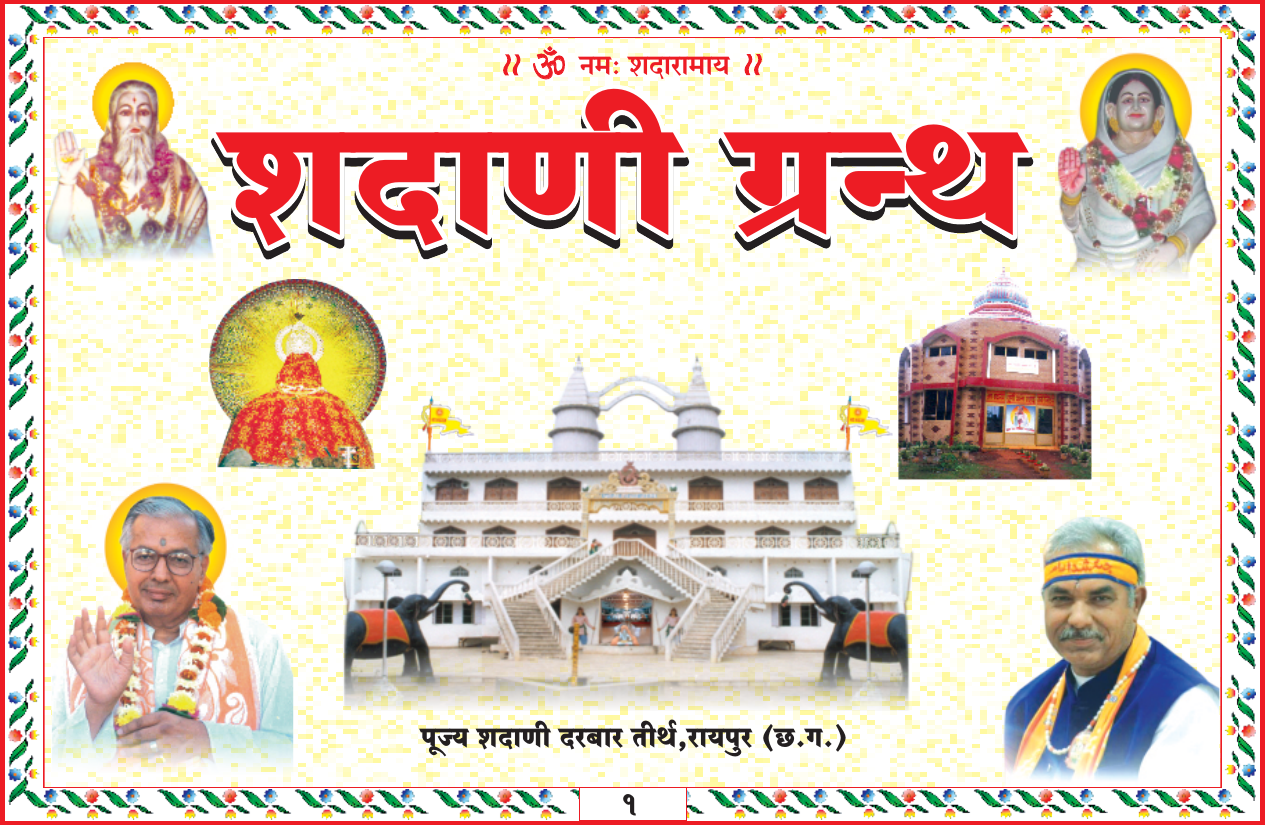
Read in the original form.
Choose a section, then turn each scanned page. No retyped text — just the Granth as it was printed.
Every page is a scan of the printed Granth, held in the original language and script.
Open the full PDFश्रवण · दर्शन
Sit with the satsang.
Bhajans for the way home, and video darshan from the official Shadani Darbar channel.
श्रवण
Bhajans for the way home.
The complete bhajan collection published on the official Shadani Darbars website — searchable by name and streamed from the source.
Official audio pageAll recordings stream and download directly from shadanidarbars.com. Playback and downloads depend on that website and your connection.
दर्शन
Darshan, from the Darbar.
A verified selection of official uploads from Shadani Darbar Official and the Darbar’s bhajan-videos page.
Visit the channelVideos are embedded from YouTube. If a video is blocked in your browser or network, use “Open in YouTube”.
Shadani Darbar OfficialLive streams, satsang and community videos on YouTube. Open channelइतिहास · गद्दी परंपरा
Nine Gaddisars, one living tradition.
From Sant Shadaram Sahib’s birth in 1708 to the present Gaddisar, the story of Shadani Darbar as recorded by the Darbar itself.
The line of Gaddisars
A tradition carried, generation to generation.
Shadani Darbar’s story begins with Sant Shadaram Sahib, who reached Mathelo in 1768 and later laid the foundation of the Darbar at Hayat Pitafi. The official history then follows a line of nine Gaddisars who have carried the Darbar’s spiritual and community life.
This timeline is a condensed, lightly edited version of that account. Names, dates and places are kept as the official history records them; the full text remains available at the source.
Source
Condensed and lightly edited from the official Shadani Darbar history page. This page is independent and is not the official Darbar website.
Map data © OpenStreetMap
Location accuracy: Raipur and Hayat Pitafi have site-level map references. Amravati and Mathelo are approximate city or village-area markers because a verified street address was not available in the sources reviewed. Confirm locally before travelling.
संगत
Gatherings & announcements.
Event dates appear only when an official announcement can be verified.
Upcoming events
No new dates announced yet.
As checked on 8 November 2026, the official Shadani Darbars website lists earlier 2026 programmes but no later event date. Check the official announcements for the next confirmed gathering.
Check official updates2026Last checked
Announcement archive
Recent published programmes
Source: shadanidarbars.com. This page is independent and is not the official Darbar website.